How Table Geometry Affects Rare Earth Mineral Separation
Rectangular Deck Tables
Traditional concentrating tables use rectangular decks with parallel riffles running across the width. Feed pulp enters at one corner, and the table's reciprocating motion, combined with wash water, stratifies particles by density. Heavy particles settle to the bottom layer and move along the riffles toward one discharge point. Light particles stay near the top and wash across the riffles toward another discharge point. Intermediate-density particles flow along paths between these extremes.
This design has been refined over a century and works effectively for many separations, particularly when density differences are substantial. However, the uniform deck width creates constraints. Riffles must span the full width to maintain structural integrity, limiting how thin they can be made. Intermediate-density particles, the most difficult to separate, travel a relatively short path through the riffled area before discharge.
Deister's Rhomboidal Deck Design
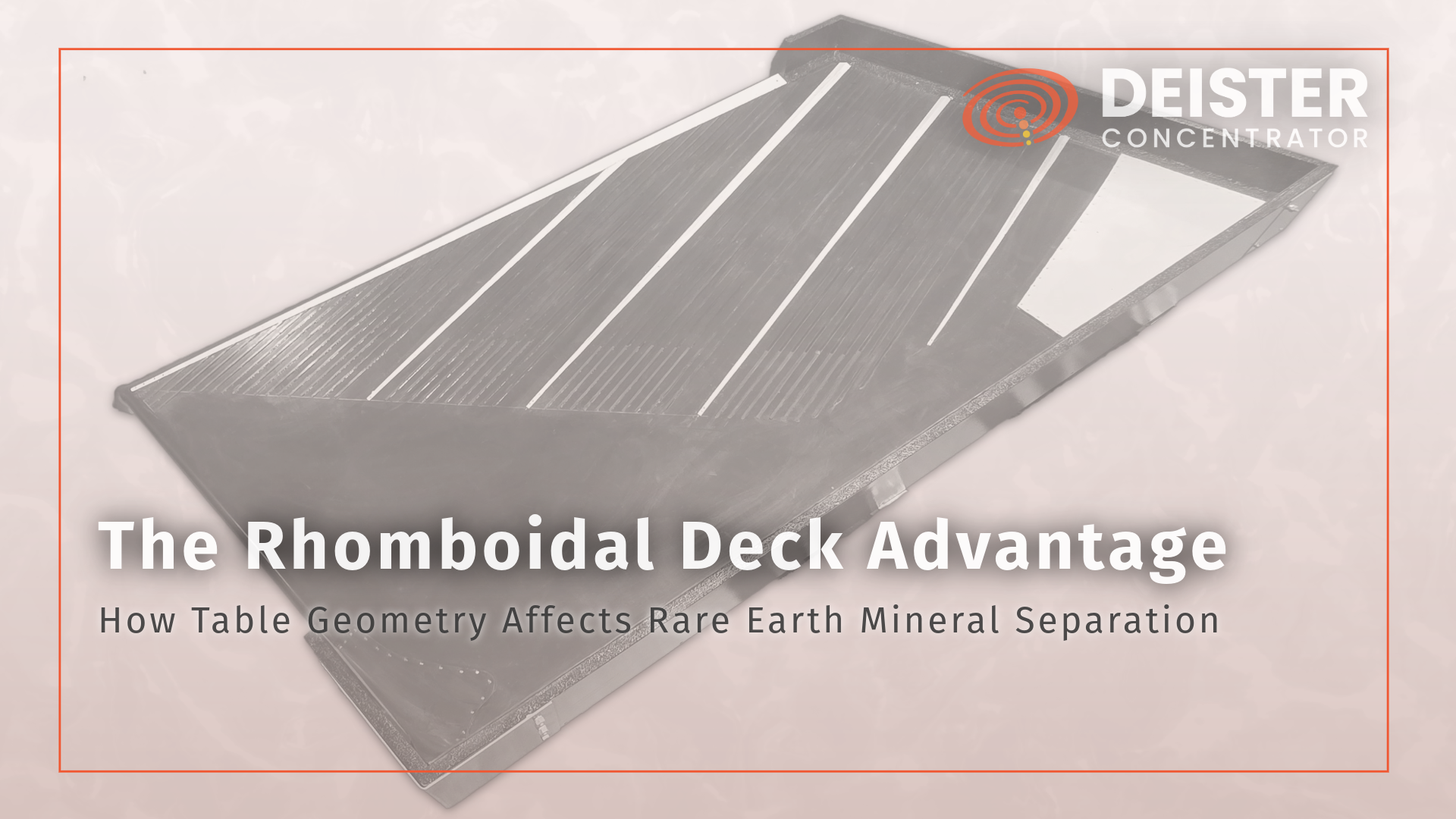
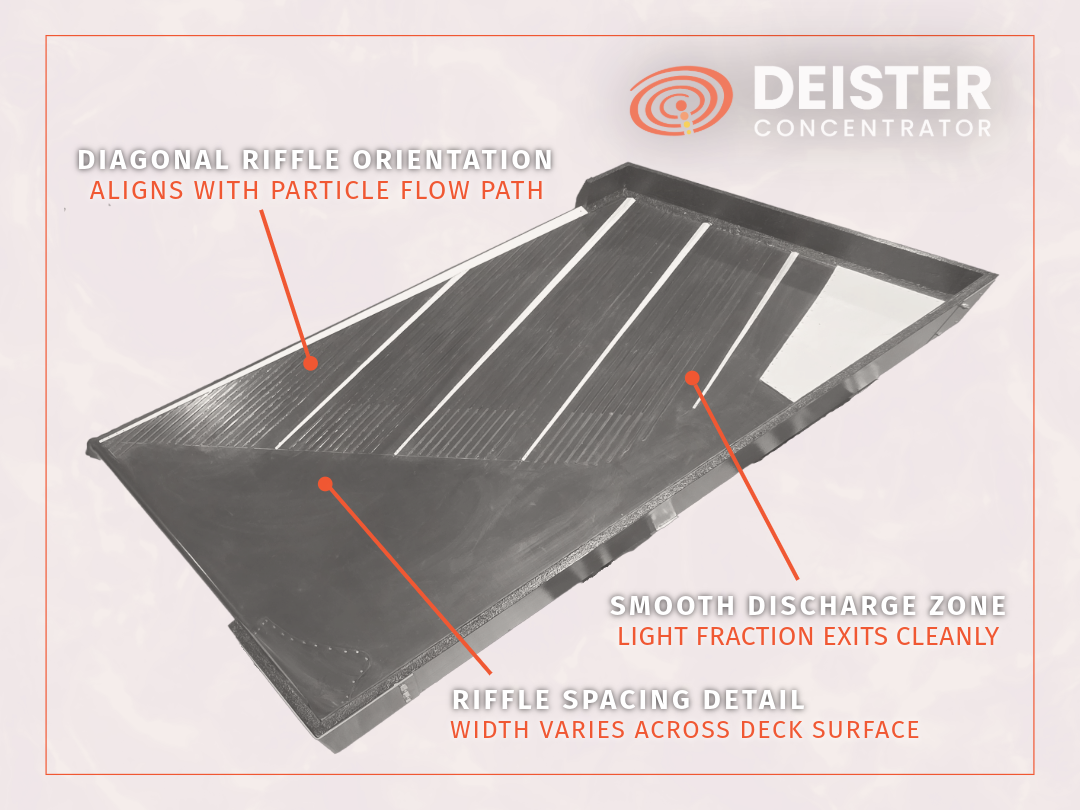
Deister developed an alternative approach: shaping the deck as a rhomboidal or diagonal form rather than a rectangle. This rhomboidal-deck configuration aligns the geometry with the natural diagonal flow patterns that develop in stratified pulp under reciprocating motion.
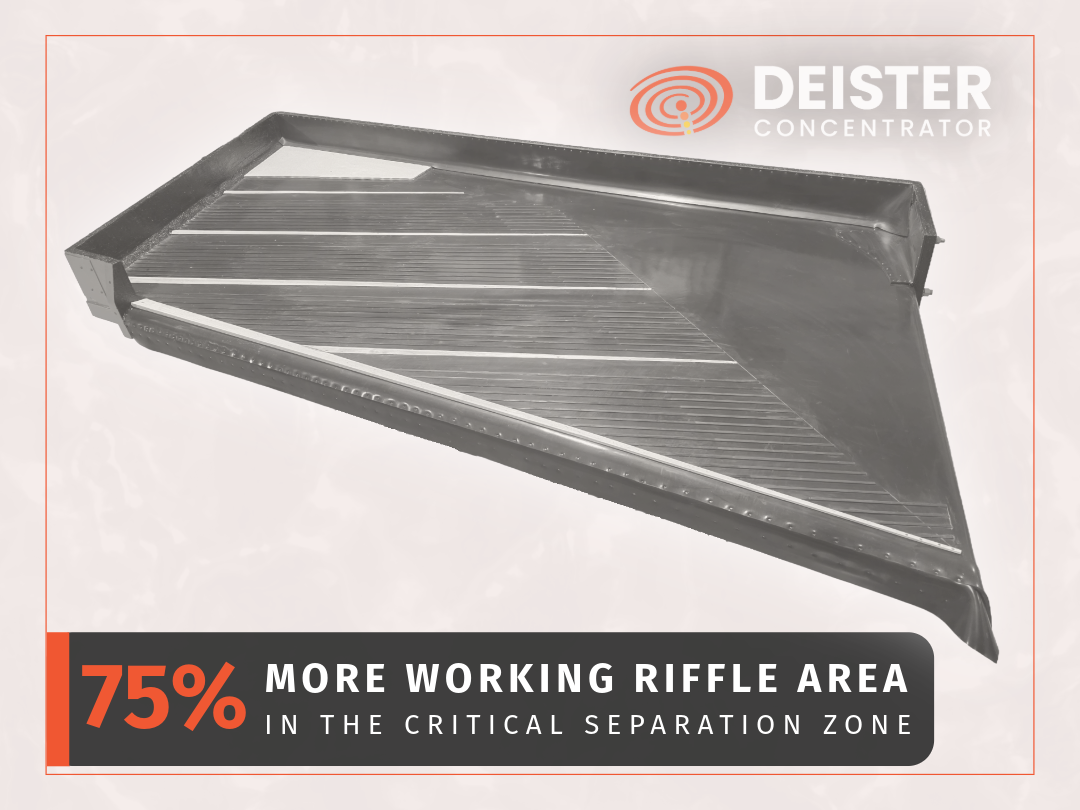
The result: particles in the intermediate density range travel a longer path across a more riffled surface. The diagonal configuration provides approximately 75% more working riffle area in the intermediate gravity zone compared to rectangular decks of similar size.
In gravity separation, the more surface area particles interact with riffles in the critical density range, the more thoroughly they can be separated. More working riffle area means:
- Better stratification: Particles have more opportunity to settle into their proper density layers
- Sharper separations: The gradual transitions between products become more distinct
- Improved recovery: Less valuable material is lost to middlings or tailings
- Higher grade concentrates: Better separation of closely graded minerals
For monazite (SG 4.9-5.3), zircon (SG 4.7), and ilmenite (SG 4.5-5.0), this additional interaction surface matters.
The diagonal geometry also permits thinner riffles in zones where intermediate particles concentrate. Thinner riffles improve particle spreading across the deck, which enhances density-based separation when working with closely-graded minerals.
Motion Systems
Table motion affects separation efficiency. Simple back-and-forth "bumping" motion moves particles, but differential motion, where forward and return strokes differ, creates better stratification. Deister's rhomboidal deck geometry works with this differential motion, allowing heavy particles to advance along riffles while light particles wash across them.
Deister tables use gear-driven eccentric motion with adjustable stroke length, allowing operators to tune performance for different materials and particle sizes.
Application to Rare Earth Processing
Commercial beach sand operations have processed monazite, zircon, ilmenite, and rutile for decades. Deister rhomboidal-deck tables have been used in these operations across multiple continents, processing the same heavy mineral assemblages that rare earth projects face, minerals clustered within a narrow specific gravity range requiring precision separation.
Evaluating gravity concentration technology for your rare earth project?
The Deister team can discuss how rhomboidal-deck geometry applies to your specific mineralogy and ore characteristics.