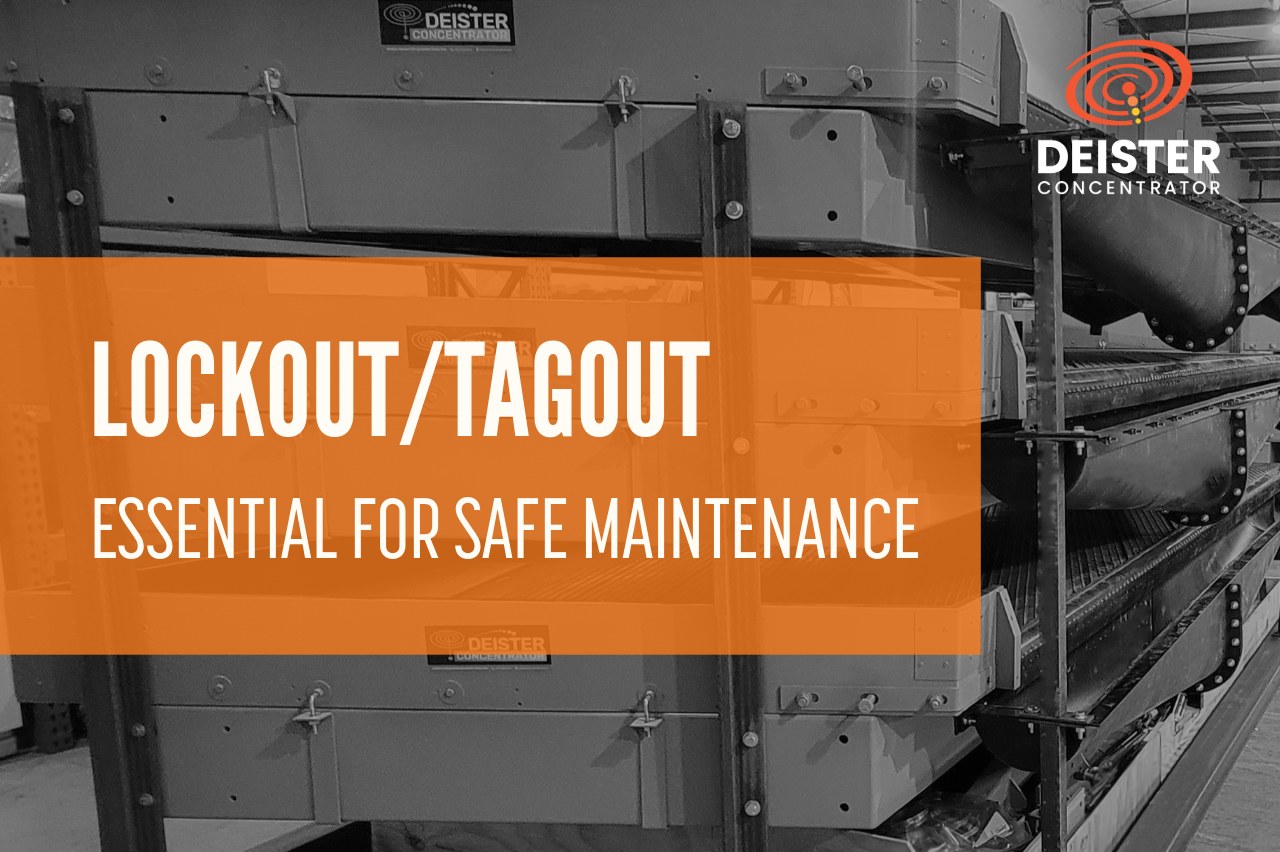
Routine maintenance keeps your concentrating table running efficiently, but it also puts operators closest to potentially dangerous components. Proper lockout/tagout procedures and safe maintenance practices protect your team during essential service work.
Understanding Lockout/Tagout
Lockout/tagout (LOTO) is required whenever you perform maintenance, make adjustments that require removing guards, clear blockages, replace wear parts, or service drive systems.
The Basic LOTO Process:
Prepare
Identify all energy sources on your equipment—electrical power, hydraulic systems, pneumatic controls, mechanical springs, and counterweights.
Notify
Inform everyone in the area that the equipment will be locked out. Post clear signage at control stations.
Shut Down
Turn off equipment using normal shutdown procedures to allow controlled stopping.
Isolate Energy
Lock the electrical disconnects in the OFF position using your personal lock. Close and lock hydraulic or pneumatic control valves. Block or support components that could move.
Release Stored Energy
Allow springs and counterweights to settle completely. Bleed pressure from all pneumatic and hydraulic systems. Verify suspended components are properly supported.
Verify Isolation
Attempt to start the equipment—it should not respond. Test that the power is truly off before beginning work.
Complete Work Safely
Only after verification should maintenance begin.
Restore Equipment
Before removing locks, ensure all personnel are clear, guards are reinstalled, and tools are removed. Each worker removes only their own lock—never remove another person's lock.
Safe Deck Handling
Deck changes present significant hazards due to weight and suspended loads.
Key Safety Points:
- Complete full lockout/tagout before beginning
- Use proper lifting equipment—never attempt to manhandle heavy decks
- Support decks mechanically before disconnecting any attachments
- Never work under suspended loads without proper mechanical support
- Store removed decks on stable, level surfaces
If manual positioning is necessary, use proper lifting technique: lift with legs, position multiple workers at balanced points, and designate one person to coordinate with clear verbal commands.
Critical Component Maintenance
Swivel Connectors
These high-stress components require weekly inspection. Check for looseness during operation or while stationary—any play indicates immediate replacement is needed. Replacement requires a complete lockout and proper deck support to relieve the load before removing the mounting hardware.
Head Motion Service
Service of the head motion assembly requires a complete lockout and should only be performed by trained personnel. Follow manufacturer procedures exactly for cover removal, bearing service, and reassembly. Components are precisely positioned and under stress—incorrect reassembly can cause failure.
Lubrication Tasks
Even routine lubrication should be performed with equipment shut down and locked out when working near other moving components. This prevents exposure to unexpected hazards.
General Maintenance Safety Principles
Never Rush
If a procedure doesn't feel safe, if equipment behaves unexpectedly, or if you're unsure about any step—stop and get help. No maintenance task is urgent enough to risk injury.
Use Proper Tools
Having the correct tools and replacement parts available reduces pressure to improvise or rush repairs.
Work as a Team
Heavy or complex maintenance tasks require multiple people. Coordinate clearly and ensure everyone understands the procedure.
Follow Procedures
Manufacturer maintenance procedures exist for safety and equipment longevity. Follow them carefully, especially for critical components.
Maintaining Safety During Maintenance
Proper maintenance practices protect both people and equipment:
- Keep critical spare parts in stock to enable planned maintenance rather than emergency repairs
- Document maintenance activities to track wear patterns
- Report unusual conditions or difficulty during maintenance tasks
- Ensure all personnel performing maintenance understand lockout procedures
- Verify guard reinstallation before returning equipment to service
Conclusion
Safe maintenance requires planning, proper procedures, and never taking shortcuts. Equipment maintained safely and systematically performs better and lasts longer than equipment serviced under time pressure with improvised methods.
Strong lockout/tagout practices, proper lifting techniques, and systematic maintenance procedures create an environment where service work is routine rather than risky.
For technical support or maintenance questions about your Deister equipment, contact us.
Keep critical maintenance parts in stock for planned service.